

近日,初光跃迁宣布完成数亿元种子轮融资,辰韬资本、小米战投、BV百度风投、芯禾资本等悉数入局。这家公司成立不足5个月,创始人却有一个响亮的名号,地平线HSD核心技术负责人张颖,业内人称“端到端战神”。他带队攻坚过有图、无图、纯视觉一段式端到端三代智驾方案,把量产系统推到最接近特斯拉FSD的水平。资本市场用真金白银投票的那一刻,外界先记住的,其实是一句追问,一个智驾老兵,为什么要转身去做机器人。
Recently, Chuguang Yueqian announced completion of a seed round worth hundreds of millions of yuan, with Chentao Capital, Xiaomi Strategic Investment, BV Baidu Ventures, and Xinhe Capital all participating. The company is less than 5 months old, but its founder has a响亮 title—Horizon HSD core technology lead Zhang Ying, known in the industry as the "End-to-End God of War." He led teams through three generations of intelligent driving solutions—mapped, mapless, and pure-vision one-stage end-to-end—pushing mass production systems to the level closest to Tesla FSD. The moment capital voted with real money, what the outside world remembered first was actually a question—why would a veteran of intelligent driving turn to robotics.
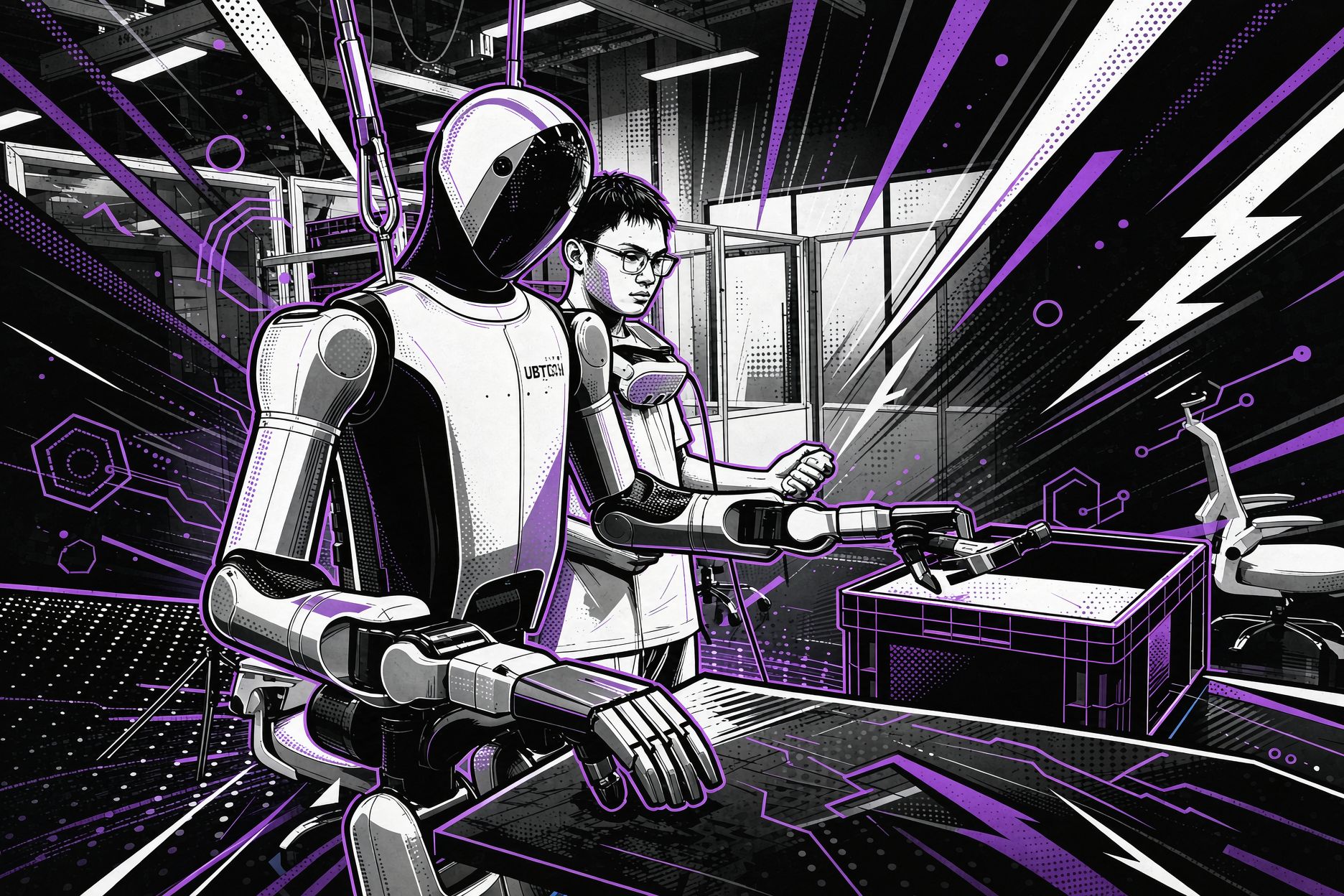
张颖自己的解释很干脆。自动驾驶验证过的端到端方法论,本质上是一套感知、推理、执行的通路,它不该被方向盘框死,也能泛化到更广阔的机器人操作场景,让模型在非结构化环境里实时感知、快速推理、精准执行。这个判断的底气,来自9月23日的一份成绩单,公司核心产品Simate-beta在RoboDojo评测榜上以平均Score 33.95登顶,成功率27.96%,压过GPT-6-Astra、DeepMind等对手,还在真机上完成了一段多步骤的泡茶任务,展现出连续操作里的状态追踪与环境适应能力。
Zhang Ying's own explanation is crisp. The end-to-end methodology validated in autonomous driving is essentially a perception-reasoning-execution pathway; it should not be boxed in by a steering wheel and can generalize to broader robot manipulation scenarios—letting models perceive in real time, reason quickly, and execute precisely in unstructured environments. The confidence behind this judgment comes from a September 23 report card—the company's core product Simate-beta topped the RoboDojo evaluation leaderboard with an average Score of 33.95, 27.96% success rate, beating GPT-6-Astra, DeepMind, and others, and completed a multi-step "tea making" task on a real machine, demonstrating state tracking and environmental adaptation in continuous operations.
榜单当然会被人追赶,星动纪元、LiberAI很快也爬了上来。张颖真正押注的并不是某一刻的榜首,而是Physical RSI,物理智能递归自我改进,简单说,就是让AI自己去研究机器人怎么变聪明。他搭建的AutoResearch系统,把提出假设、规划实验、执行验证、分析迭代的闭环交给机器自动运转,人类研究员只负责抛方向、定约束。据公司披露,MIT、清华、北大、港科大等高校的研究者已陆续进入这个平台内测。
Leaderboards will naturally be chased—Xingdong Era and LiberAI soon climbed up too. What Zhang Ying truly bets on is not a moment's top ranking but Physical RSI—Physical Recursive Self-Improvement. Simply put, letting AI research how to make robots smarter itself. The AutoResearch system he built hands the closed loop of proposing hypotheses, planning experiments, executing validation, and analyzing iterations to machines for automatic operation, with human researchers only responsible for setting directions and defining constraints. According to company disclosures, researchers from MIT, Tsinghua, Peking University, HKUST, and other universities have successively entered the platform's internal testing.
这背后藏着一个更刺痛行业的真相。物理AI最大的瓶颈从来不是模型不够大,而是研发范式太慢,每加一个新任务,就要重采数据、重训模型、重调工程,迭代效率卡在人海战术上。当AI开始研究AI,实验可以并行跑几十条路线,失败的方向在仿真里先被淘汰,只有真正有潜力的方案才上真机。这才是Simate-beta三个月登顶的真正引擎。张颖的创业,其实是整个行业人才流向的一次注脚。自动驾驶顶级工程人才正在系统性转向Physical AI,机器人研发开始Agent化、基础设施化,产业进入了以理解和干预物理世界为核心的新阶段。
Behind this lies a truth that stings the industry more. Physical AI's biggest bottleneck has never been models not being large enough but R&D paradigms being too slow—every new task added requires re-collecting data, retraining models, and re-adjusting engineering, with iteration efficiency stuck on "human wave tactics." When AI begins researching AI, experiments can run dozens of routes in parallel, failed directions are eliminated in simulation first, and only truly promising approaches go onto real machines. This is the real engine behind Simate-beta topping the leaderboard in three months. Zhang Ying's startup is actually a footnote to the entire industry's talent flow. Top autonomous driving engineering talent is systematically turning to Physical AI, robot R&D is becoming Agent-ized and infrastructure-ized, and the industry has entered a new stage centered on understanding and intervening in the physical world.
一个曾经的端到端战神,把量产战场上磨出来的方法论搬进了物理世界,也把一条让机器自己进化的路摆到了台面上。Physical RSI这个提法,和前面讨论的欧拉万象的Real-World RSI、弦引未来的Physical RSI、NEXFORM新元体的Physical RSI是同一个方向。这几家公司不约而同地把递归自我改进作为核心技术路线,说明这个方向正在成为具身智能行业的一个共识。递归自我改进的核心,是让系统参与自身学习过程的设计与改进,而不是依赖人工反复调试和重新编程。这个方向如果跑通,具身智能的迭代效率会有质的提升,物理AI的GPT-3时刻或许比想象来得更快,而这一次,定义它的可能不再是硅谷。
A former end-to-end god of war moved methodology honed on mass production battlefields into the physical world and put a path of "letting machines evolve themselves" on the table. The Physical RSI formulation aligns with the Real-World RSI discussed earlier at Ola Universe, Xianyin Future's Physical RSI, and NEXFORM's Physical RSI. These companies coincidentally taking recursive self-improvement as their core technical route indicates this direction is becoming an embodied intelligence industry consensus. The core of recursive self-improvement is letting systems participate in designing and improving their own learning processes rather than relying on manual repeated debugging and reprogramming. If this direction works, embodied intelligence iteration efficiency will see qualitative improvement, and Physical AI's GPT-3 moment may come faster than imagined—and this time, it may no longer be defined by Silicon Valley.


